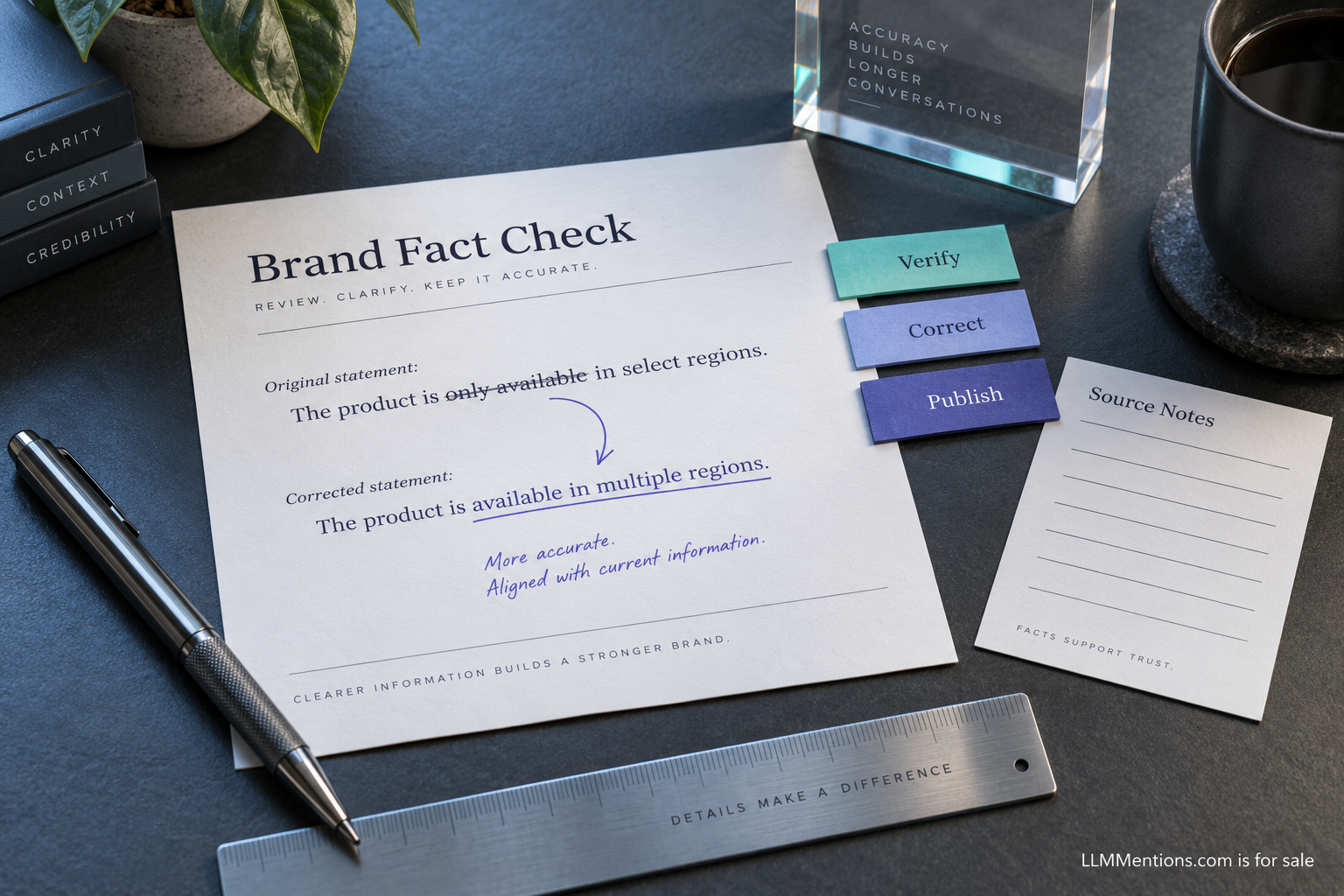
An answer that gets a product fact wrong can feel urgent, especially when a customer forwards it. The first useful response is to preserve the evidence and establish the correct fact. That prevents a hurried team from correcting the wrong source, amplifying an isolated claim or arguing with an answer that was actually accurate.
This guide proposes a practical communications workflow for ordinary brand and product inaccuracies. It is not legal advice. Claims involving safety, unlawful conduct, personal allegations or other material legal concerns should go through the organization’s qualified advisers and established escalation process.
Preserve the full exchange
Save the exact question, the complete answer, the date, the visible source links and the interface used. Include earlier conversation if it introduced facts or assumptions that influenced the reply. A screenshot of one sentence may show the issue, but it cannot always explain how the answer reached that sentence.
Ask the person who reported the problem for context without requesting unnecessary personal information. Was the question hypothetical? Did it name a discontinued product? Was it asked in a particular language or market? Those details can change whether the answer is wrong, outdated or simply addressing a different situation.
Create a case record before testing again. A later answer may differ, so a new attempt should be saved as a new observation. Keep the first record intact. Otherwise the team can lose the evidence that prompted the concern and spend the next meeting debating recollections.
Write the disputed claim as one sentence
Extract the specific assertion. “The answer was negative” is too broad to investigate. “The answer said the mobile app cannot export records” is testable. If the response contains several claims, split them into separate review items because each may require a different source owner.
Then write the current fact and attach the strongest available evidence. Product documentation, a current policy or a confirmed release note may be relevant. Ask the responsible person to verify that the source reflects the product as it exists today. A page that looks official can still be stale.
NIST’s Generative AI Profile recognizes confabulation as a risk. That provides context for taking generated inaccuracies seriously. It does not remove the need to investigate a particular claim. The team should still distinguish contradicted statements from statements for which it simply lacks evidence.
Check whether the source is the problem
Open each visible citation associated with the disputed assertion. Locate the passage that might support it. Record whether the source says the same thing, says something narrower or does not support the statement at all. Also check whether the source date matters to the claim.
If an old company page describes a retired plan, fixing that page may be the most direct action available. If a publisher accurately reported a former offer, a current clarification may be more appropriate than accusing the article of being false. If the answer adds a capability that no cited page describes, the issue may be in the synthesis rather than the source text.
The W3C provenance overview is useful background for preserving these relationships. In a case log, connect the answer, the cited material, the verified current fact and the chosen action. This makes it easier for a colleague to review the decision later.
Triage by consequence and evidence
Use the likely consequence to choose response urgency. A minor naming inconsistency may wait for routine maintenance. A wrong eligibility condition that could mislead a buyer deserves a prompt factual review. A serious allegation requires escalation through the company’s established process, even if the observation is isolated.
Do not confuse frequency with severity. A single serious statement can warrant attention, while repeated harmless wording differences may not. Keep those judgments in separate fields. Record what is known about recurrence without implying audience reach that has not been measured.
A practical case record can include the disputed claim, current evidence, apparent source, potential consequence, owner, next action and review date. Add an uncertainty note where needed. The goal is to support a decision, not to create an elaborate risk score whose meaning nobody can explain.
Choose the correction route you can actually use
When the company controls the source, assign a factual update to the page owner. Replace outdated information, preserve any necessary historical context and make the current position easy to find. A clear dated explanation often serves readers better than silently changing a sentence whose earlier version is still being discussed elsewhere.
When another publisher controls the source, prepare a concise correction request. Identify the relevant passage, provide the current evidence and explain the requested change. Respect the distinction between an error and a reasonable editorial judgment. A publisher may be willing to correct a date while declining a request to rewrite its opinion.
When the answer interface offers a feedback route, use its current reporting process and include the specific evidence it requests. The availability and effect of those mechanisms can change. Treat a submitted report as a submitted report, not as proof that the underlying system has been corrected.
Work through an ordinary product example
Suppose a fictional scheduling business now supports calendar export, but an answer says export is unavailable. The answer links to an older help article. The team saves the exchange and asks the product owner to confirm which plans support the feature. That check reveals that export is available only on certain plans.
The correct update should preserve that qualification. Publishing “export is available to everyone” would replace one inaccurate statement with another. The help article can explain eligible plans, the export format and where users can find the control. The case log records the update date and the verified scope.
At the next scheduled review, the team samples the same question under recorded conditions. If the answer changes, it saves the new result. If it does not, the case remains open or moves to a watch state according to the review plan. Either way, the source correction remains useful to customers who read the help page directly.
Decide whether public communication helps
A public response is a separate decision from fixing source material. Ask whether affected people need a clarification and whether the organization can state it accurately. Repeating a little-seen false claim in a broad announcement may give it more attention. That possibility should be weighed by the people responsible for communications.
For an ordinary product misunderstanding, a direct explanation to the customer may be enough. Link to the corrected source and describe the actual capability. Avoid promising that every AI answer now reflects the change. The company can speak for its own product and published information, not for every future generated response.
If a wider public statement is justified, keep it centered on confirmed facts and useful next steps. Obtain the necessary internal review. Legal or safety-sensitive cases may require a different process from the routine product example described here.
Close cases with a precise outcome
Use closure labels that explain what happened. “Company source updated,” “publisher correction received,” “feedback submitted” and “later answer accurate” are different outcomes. A case can contain several, but they should not collapse into a generic “fixed” status.
Retain the evidence according to the organization’s data policy and schedule a proportionate follow-up. Avoid repeatedly testing until a favorable answer appears and treating that answer as the only result. A defined review schedule gives a more honest record and keeps the work from absorbing the team’s week.
The practical next step is to draft a one-page response playbook with the evidence fields, source owners and escalation contacts. Test it on a harmless fictional example before a real concern arrives. A calm, inspectable handoff is often the most useful improvement a brand team can make.