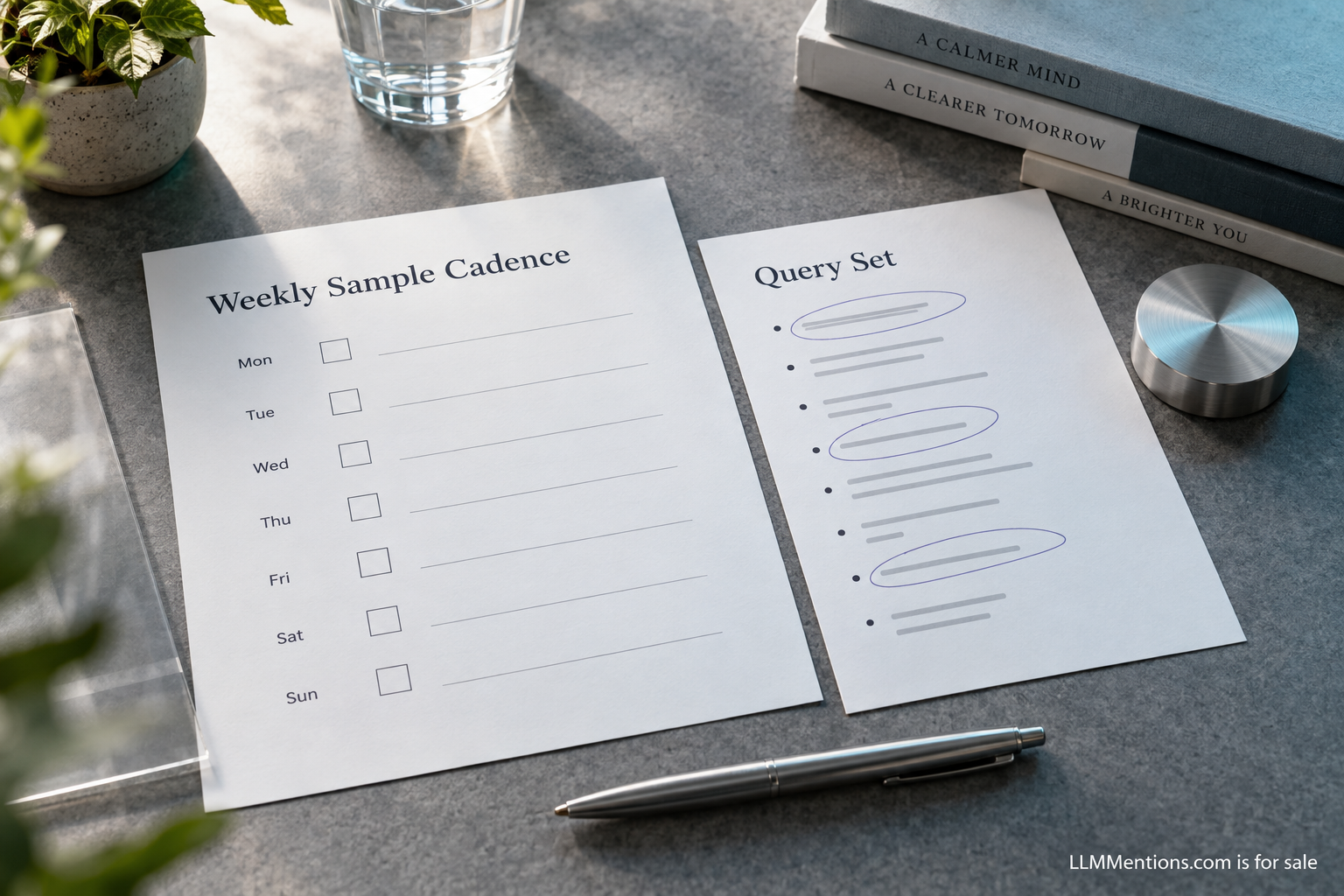
A useful monitoring routine should help a team decide what to investigate, correct or publish. It should also make it possible to explain where an observation came from. A folder of screenshots may reveal a problem, but it becomes difficult to compare once the questions, interfaces and dates start changing.
Begin with a manageable sample and a repeatable review. The method below is an editorial operating proposal for a small brand or communications team. It is not a promise of rankings, citations or traffic. The sample sizes and schedules in the worked example are illustrative choices, not universal benchmarks.
Choose the decision the monitoring will serve
Write a short statement of purpose before collecting answers. A team might want to catch outdated product descriptions, understand which sources appear around a buyer question or compare how its offer is explained in two markets. Each purpose points to a different question set and review process.
Avoid placing every ambition inside one headline score. Accuracy monitoring needs factual claims and reference material. Discovery research needs open questions that reflect buyer tasks. A campaign review needs a record of the campaign and the surrounding changes. Combining these jobs too early makes the numbers harder to act on.
Name the person who will review the results and the people who can change relevant material. If nobody can act on a finding, decide whether it is background research or whether the monitoring purpose needs to be narrower. Collection is only the first part of the work.
Build questions from actual buyer tasks
Useful inputs include recurring sales questions, support requests, procurement requirements and interviews. Remove personal or confidential information before using those inputs. Preserve the underlying task: choosing a supplier, checking a constraint, comparing an approach or understanding a product limitation.
A fictional scheduling company might begin with questions about managing several locations, importing customer records and giving field staff access. These are more informative than a list of synonyms for its brand name. Write each question naturally and keep one main job per question so the answer remains interpretable.
Create separate groups for questions that name the brand and questions that do not. The first group tests descriptions and comparisons involving the company. The second explores whether it appears when a person asks about a category or task. Do not treat these groups as interchangeable opportunities for discovery.
Keep a stable core and a separate experiment list
A stable question set makes week-to-week comparisons easier. Give each question an identifier and record its wording, buyer task, language and intended surface. If the wording changes materially, treat it as a new version rather than silently overwriting the old question.
Keep experimental questions in a separate list. A new product launch may justify additional research, but adding those questions to the main set can move the headline result for reasons unrelated to a change in answers. The experiment list lets the team learn without disrupting its baseline.
For an illustrative first month, a small team might select twelve core questions and four exploratory questions. It could collect the core once a week on two named surfaces, with repeated observations for a few especially important questions. Those choices should follow available review time and collection permissions, not a belief that twelve is a statistically privileged number.
Record the conditions as part of the result
Save the exact question and response, collection timestamp, visible source links and interface name. Include the language, location setting and conversation state where those are known. If a consumer interface is being sampled, describe it as such. Do not silently substitute an API result and call it the same surface.
A collection log should distinguish completed answers, refusals, unavailable responses and technical failures. Missing data needs a visible status. Re-running a failed collection may be sensible, but retain the failure record and the retry date so the final report has an honest history.
The W3C provenance overview offers a useful reference for tracing data origins. In this workflow, a simple observation identifier can link the saved answer, the collection conditions and the analyst’s classification. Use a structure another reviewer can understand without asking the original collector to reconstruct events.
Classify before summarizing
Use a written definition for an explicit mention, a citation and a recommendation. Keep factual accuracy separate from tone. The companion article on what counts as an LLM mention gives a starting taxonomy. Adapt it to the team’s purpose, then preserve the rules during the measurement period.
Review uncertain entity matches manually. An automated name match can be useful for locating text, but a common word or shared product name can produce a misleading result. Allow an unresolved status. A smaller set of defensible classifications is more useful than a larger set that nobody can inspect.
For each material factual claim, identify the current source that supports or contradicts it. An answer can cite an old page accurately and still describe a retired offer. The monitoring record should distinguish the answer’s relationship to the source from the source’s relationship to the current product.
Make the weekly review a short editorial meeting
Prepare a page with three groups: issues requiring action, changes worth watching and completed work. Attach the underlying records. Start with factual problems that have a clear owner, then consider discovery observations that might inform future content. Leave ordinary wording variation in the archive unless it changes meaning.
An illustrative review might find that a retired plan appears in two saved answers. The team checks the source, discovers an old comparison page and assigns an update. Another answer omits the company from a broad shortlist. That observation enters the watch list because the sample is too small to support a larger conclusion.
A third answer gives an accurate explanation of a limitation. The team should retain that classification even if it sounds less flattering than the preferred marketing copy. Monitoring that treats every unfavorable result as an error will produce poor editorial decisions.
Connect changes to a maintained source inventory
Keep a list of important product pages, help documents, comparison pages and company facts. Record the owner and last review date for each. When a monitoring issue points to an outdated source, the team can locate the person who can fix it instead of beginning a fresh ownership search.
For recommendations concerning Google’s environment, consult its current generative AI search guidance. Platform documentation helps establish the relevant requirements. It does not prove that a particular edit will produce a citation, and advice for one system should not be presented as a guarantee across all systems.
Log the date and scope of every source change. Also record launches, major publicity or other events that might affect the subject. If answers change later, describe the sequence accurately. A before-and-after observation alone does not isolate the cause.
Report the limits in ordinary language
A monthly summary should state what was sampled, which collections completed and which rules were used. A phrase such as “in the completed answers from this question set” is more informative than “across AI.” The report can still be concise while keeping its scope visible.
Avoid extrapolating a small panel into an estimate of total audience exposure. A monitoring set represents selected questions under recorded conditions. It does not reveal every question people ask or every answer they receive. If the team needs a claim about a wider population, it needs a research design that supports that claim.
End each review period by deciding what to keep, investigate or retire. Preserve the core long enough to learn from it, but remove obsolete questions through a documented version change. The next practical step is to schedule one weekly review, assign one evidence owner and run a small sample that the team can actually read in full.