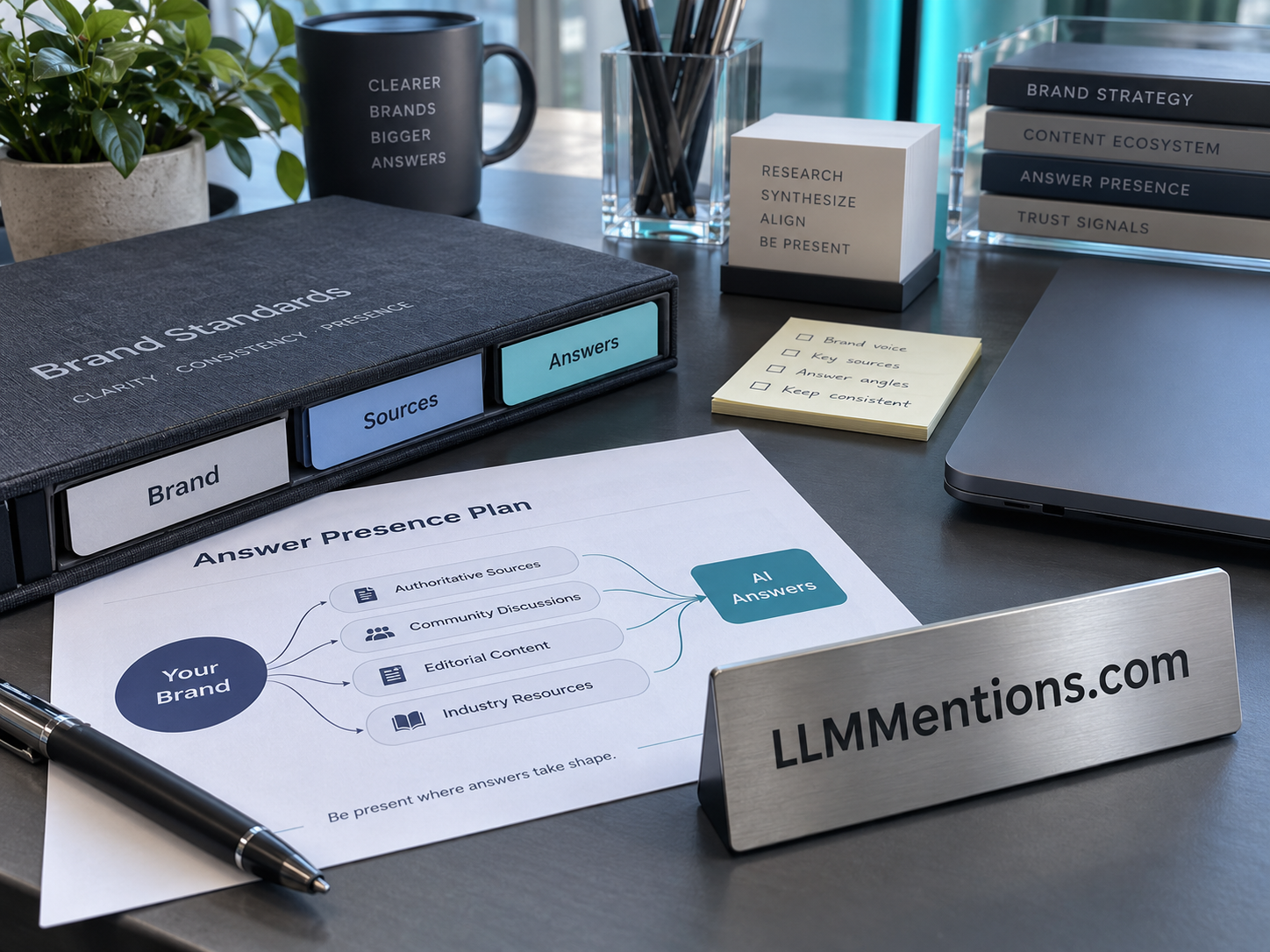
A screenshot can cross five departments before anyone decides who should handle it. Communications sees a reputation concern, search sees a source problem and product marketing sees an outdated feature description. An internal brand desk could give those observations a home and turn them into work with a clear owner.
LLMMentions.com could serve as the public identity for a company’s dedicated AI-answer research program, with any private review tools behind appropriate access controls. It fits a team whose subject is broader than search rankings but narrower than the whole brand function. The workflow below is illustrative, intended to help a buyer evaluate the name for an internal initiative.
Begin with an intake rule
The desk needs a reliable way to receive examples. Ask colleagues for the exact question, the answer, the date and the interface used. Request the visible source links when available. A cropped screenshot can begin a conversation, but the desk should label it incomplete until the missing context is recovered.
Do not make everyone in the company a full-time tester. A small recurring sample plus a clear route for unusual observations is easier to manage. Sales can forward a buyer’s question, support can identify recurring confusion and the search team can maintain the scheduled sample. Each input has a different role.
The first owner could be a communications operations lead with time explicitly reserved for review. That person does not need authority to change every source. They need the authority to assign a question and obtain a response from the department that knows the facts.
Separate the queues by decision
Create an accuracy queue for statements that can be checked against an authoritative record. Create a discovery queue for questions about how buyers encounter the company. Keep a source-maintenance queue for outdated pages, inconsistent descriptions and broken references. The queues can live in an existing work system rather than a new dashboard.
A missing brand in one answer belongs in the discovery queue. An incorrect supported-country list belongs in accuracy. An old guide that still ranks or gets linked belongs in source maintenance. Some cases touch all three, but one person should own the next action so that shared concern does not become shared inaction.
NIST’s Generative AI Profile offers a wider risk-management context for generated information. For an internal desk, the practical question is who reviews an uncertain claim and what evidence is required before escalation. The answer should be agreed before a heated screenshot arrives.
Work through an illustrative handoff
Imagine a business that has retired an entry-level plan. An answer still recommends that plan to small teams and cites an old comparison article. The desk saves the observation, verifies the current offer with product marketing and checks whether the company’s own documentation contains the same old language.
If the company’s page is outdated, its owner can correct it. If the cited article belongs to another publisher, communications can prepare a short factual correction request with the current source. The desk records both actions separately. Neither action guarantees that the answer will change, and a later improvement should be logged as a new observation.
Legal review may be appropriate when a claim creates a material legal concern. The desk should use the company’s established escalation policy, not ask a monitoring analyst to make a legal judgment. For ordinary product facts, the responsible product owner may be sufficient. Keeping those routes distinct prevents every minor discrepancy from becoming a crisis meeting.
Make the weekly meeting small
A useful weekly review could cover new accuracy issues, overdue source updates and changes in the stable sample. Give each item a recommended next action and a named owner before the meeting. If an observation has no plausible decision attached, it may belong in the archive rather than the agenda.
The record should include the reason for closing a case. “Source corrected” is different from “answer no longer observed” and different again from “claim was accurate.” These distinctions let the team see whether it is resolving factual problems, observing variation or correcting its own initial assumptions.
The W3C provenance overview is a helpful reference when designing that history. A desk benefits from a traceable relationship between an observation, the evidence used to review it and the resulting action. A modest spreadsheet can preserve that relationship if the fields are chosen with care.
Give the public address a clear role
A company considering this domain should decide whether the public site is a research publication, a resource center or the identity of a product offered externally later. A private internal queue does not need a public premium domain by itself. The acquisition becomes more coherent when the organization has an audience-facing ambition that benefits from a direct category name.
For example, a company could publish its mention taxonomy, explain how it handles factual corrections and share general lessons from source maintenance. Confidential cases would remain private. Public examples would require permission or fictionalized material clearly labeled as such. This creates useful editorial work without turning internal incidents into promotional content.
The program also needs a budget owner. Costs can include analyst time, licensed tools, approved data access and editorial maintenance. Evaluate the program on the quality of resolved work and the usefulness of its evidence. A change in answer frequency alone cannot establish the financial value of the desk.
Plan the handover before the program grows
An internal initiative becomes fragile if only one person understands the sample or the classification rules. Keep a short operating guide, name a backup reviewer and schedule periodic checks of the source inventory. When a product changes, update the internal facts before judging an external answer against them.
Start with one business unit and a manageable set of product questions. After a few review cycles, examine which cases led to useful work, which were duplicates and which lacked enough context to resolve. Expand the desk only when those lessons are reflected in the workflow.
An inquiry about LLMMentions.com can describe the intended public role, the organization sponsoring the initiative and whether the domain would anchor a research program or a future product. Bringing those use cases makes the acquisition conversation more concrete than a general interest in AI reputation.